What Is Anarcho-Capitalism?

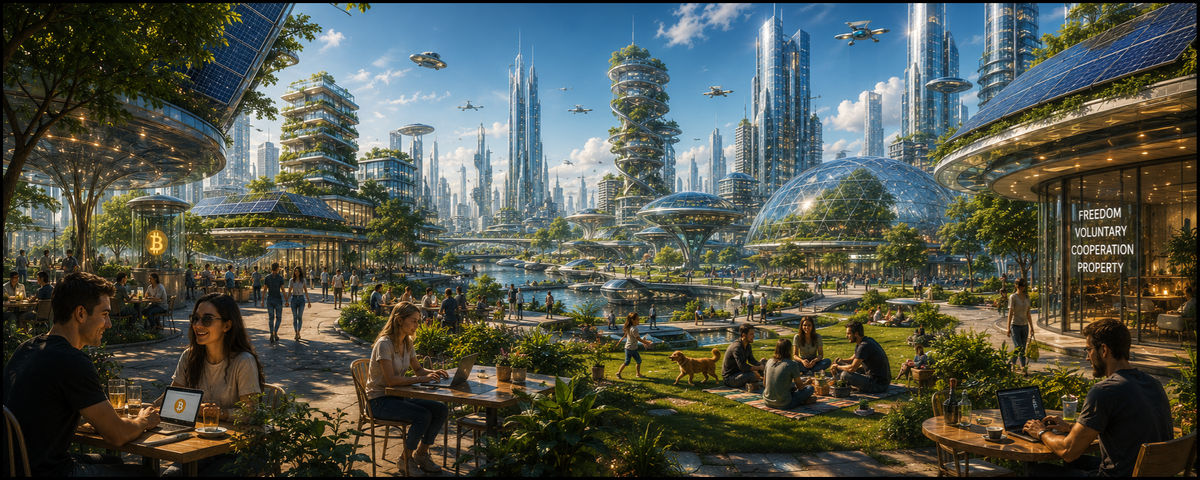
Anarcho-capitalism is a political and economic philosophy that proposes a society organized entirely through voluntary interaction, private property, and free-market systems without the existence of a traditional state. Supporters of this philosophy argue that many functions normally controlled by governments could instead be managed by private individuals, businesses, communities, and decentralized agreements between people.
At the center of anarcho-capitalist thought is the belief that individuals should have full ownership over their lives, labor, property, and voluntary exchanges. Rather than relying on centralized political institutions to organize society, anarcho-capitalism promotes the idea that free association and market competition could provide services more efficiently and with greater respect for personal freedom.
In this model, the state would either be entirely absent or pushed into an extremely limited and irrelevant role. Functions traditionally associated with government, such as security, infrastructure, arbitration, and public services, would instead be handled by private companies or cooperative agreements between individuals and communities.
Security, for example, would not necessarily depend on a government police force. Instead, people could hire private security providers based on reputation, quality of service, and contractual agreements. Different neighborhoods, businesses, or residential communities could choose the providers that best fit their needs and expectations. Supporters believe competition between private security firms could create stronger incentives for efficiency, accountability, and customer satisfaction.
Infrastructure is another area often discussed within anarcho-capitalist theory. Roads, maintenance projects, and local development would no longer be managed through centralized taxation and state planning. Instead, communities, property owners, or local associations could voluntarily organize and divide the costs of construction and maintenance among themselves. For example, residents within a neighborhood could collectively hire a private construction company to build or repair roads, public spaces, lighting systems, or other shared infrastructure based on mutual agreement.
The broader idea is that services should emerge from voluntary demand rather than compulsory taxation. According to anarcho-capitalist theory, if individuals directly pay for the services they use, providers become more responsive, competitive, and efficient because they must earn trust and satisfaction rather than rely on political authority.
Private arbitration and dispute resolution are also important elements of this philosophy. Instead of state-controlled court systems, legal conflicts could be resolved through independent arbitration agencies chosen voluntarily by the parties involved. Contracts, property rights, and agreements would play a central role in maintaining social order and resolving disputes peacefully.
Economically, anarcho-capitalism strongly supports unrestricted free markets, entrepreneurship, and voluntary exchange. Supporters often argue that innovation and prosperity emerge more naturally when markets operate without heavy regulation or centralized economic planning. They believe individuals and businesses are generally better at making economic decisions than political institutions.
Property rights are considered one of the foundational principles of anarcho-capitalism. The philosophy views private ownership as essential for personal freedom, economic stability, and voluntary cooperation. Respect for contracts and property boundaries becomes the basis for social interaction within a stateless society.
Critics of anarcho-capitalism often argue that a society without centralized government could face challenges involving inequality, corporate concentration of power, legal enforcement, or access to essential services. Questions are frequently raised about how large-scale coordination, public infrastructure, and conflict resolution would function without a state monopoly on authority. Supporters, however, argue that decentralized systems and competitive markets could solve many of these issues more effectively than centralized political structures.
Anarcho-capitalism remains largely theoretical and philosophical rather than widely implemented in practice. However, its ideas continue to influence discussions surrounding decentralization, private governance, digital currencies, voluntary cooperation, and the relationship between individual freedom and state power.
At its core, anarcho-capitalism represents a vision of society built around voluntary interaction instead of centralized authority. It imagines a system where economic exchange, private agreements, and individual responsibility become the primary mechanisms for organizing social life, replacing many of the functions traditionally associated with government institutions.