Bitcoin: The Timechain, Layers, and the Future of Digital Money
Disclaimer: This is not an investment recommendation, just a suggestion to better study how Bitcoin works. ⚡

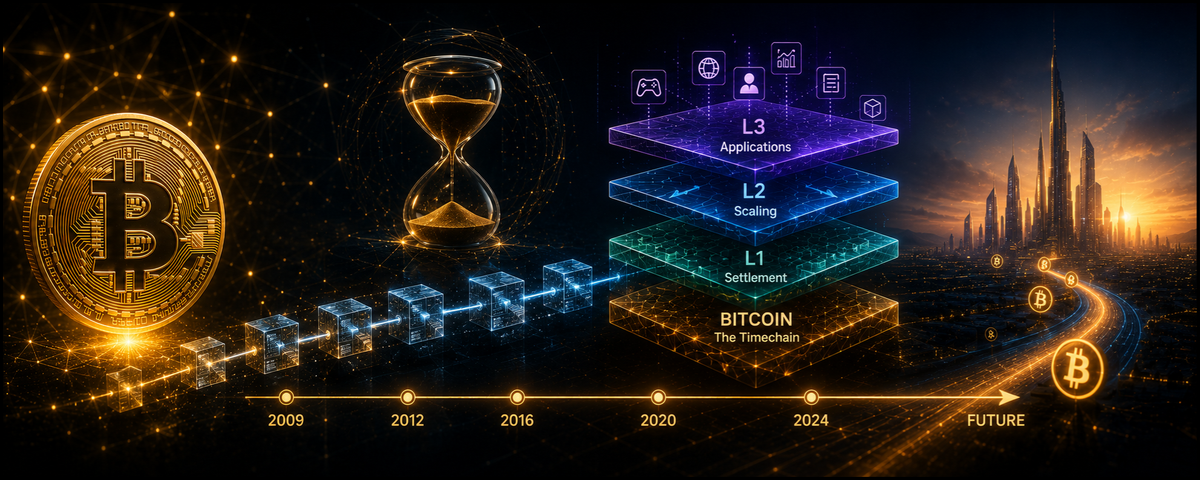
Bitcoin was created as a decentralized form of digital money designed to allow people to store and transfer value without relying on traditional financial intermediaries. Its greatest innovation was the creation of a distributed and secure network capable of operating independently through consensus and cryptography. While many refer to this system as a blockchain, a growing part of the Bitcoin community prefers the term “Timechain,” emphasizing that each block represents a permanent record ordered through time.
As Bitcoin evolved, it became increasingly clear that the main network was not designed to prioritize speed or convenience above everything else. Instead, Bitcoin’s Layer 1 was built with a different mission: maximizing security, decentralization, and resistance to censorship. This foundation is what allows Bitcoin to function as a reliable monetary system without depending on centralized control.
Layer 1 can be understood as the core of Bitcoin itself. It is the most secure layer of the entire ecosystem and is often compared to a personal vault or a bank for long-term savings. Transactions recorded on this layer become part of a permanent and immutable ledger distributed across thousands of computers worldwide. Because of the level of security involved, transactions may take longer to confirm and can become more expensive during periods of high network activity. For this reason, many people view Layer 1 primarily as a settlement layer used for protecting wealth and transferring larger amounts with maximum security.
As Bitcoin adoption expanded, the need for faster and cheaper transactions became more apparent. This challenge led to the development of the Lightning Network, commonly referred to as Layer 2. The Lightning Network was created to enable instant payments with extremely low fees while still using Bitcoin as the underlying asset. Instead of replacing the main network, it works alongside it, allowing Bitcoin to become practical for everyday payments.
The distinction between these two layers is important. Layer 1 functions as the secure foundation where long-term savings are protected, while the Lightning Network operates more like the wallet people use in daily life. Small purchases, online payments, and rapid transfers become possible without sacrificing the security model of Bitcoin itself. This layered approach allows the system to remain decentralized while improving scalability and usability.
Within the Lightning ecosystem, there is also an important difference between custodial and self-custody solutions. Custodial wallets are managed by third-party services that hold the keys on behalf of the user. This model offers simplicity and convenience, especially for beginners, but it also requires trust in the provider controlling the funds. Self-custody wallets, on the other hand, allow individuals to control their own keys directly. In this model, the smartphone effectively becomes a true personal digital wallet, reinforcing one of Bitcoin’s central ideas: financial sovereignty through direct ownership and personal responsibility.
Beyond Layer 2, the Bitcoin ecosystem continues to expand through additional technologies known as sidechains. Sidechains are parallel networks connected to Bitcoin that allow experimentation with new features and specialized applications without changing the rules of the main Timechain. Their purpose is to expand functionality while preserving the security and stability of Layer 1.
Networks such as Liquid and eCash represent examples of this broader ecosystem. These systems explore faster settlement models, digital asset issuance, privacy enhancements, and alternative transaction structures while remaining connected to Bitcoin infrastructure. The existence of sidechains demonstrates how innovation can occur around Bitcoin without forcing the core network itself to compromise its principles.
This multi-layer architecture is becoming increasingly important for Bitcoin’s long-term future. Rather than attempting to force one single network to perform every function simultaneously, Bitcoin evolves through specialization. Layer 1 focuses on maximum security and decentralization. The Lightning Network prioritizes speed and efficient daily payments. Sidechains explore experimentation and additional functionality.
The result is a system capable of growing without abandoning the principles that made Bitcoin unique in the first place. By separating responsibilities across different layers, Bitcoin becomes more scalable, accessible, and adaptable while preserving the integrity of its foundation. This structure reflects a broader vision of digital money: one where security, ownership, and freedom remain at the center of the system rather than being sacrificed for convenience alone.